
Wheels in Motion to Establish Road Rescue in North & South Shuswap
By Jo Boxwell
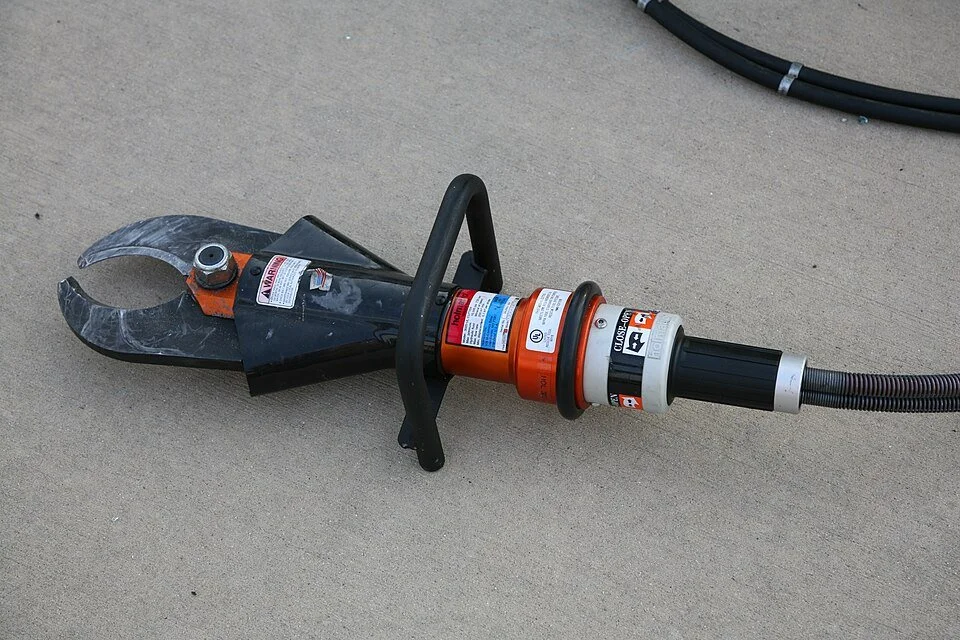
Example of “jaw's of life” emergency tool. (image: wiki commons)
As of January 1, 2026, a new taxation came into effect for property owners in CSRD Electoral Areas C, F and G to cover costs associated with establishing and maintaining road rescue services in the North and South Shuswap. This follows an Alternative Approval Process (AAP) that was held in May and June 2025 to obtain elector assent.
Road rescue is a specialized emergency service that assists with extricating people from vehicles following road incidents. Responders are trained to stabilize vehicles using items including struts, blocks and chocks, and to use tools such as hydraulic spreaders (commonly known by the brand name “jaws of life”), cutters, rams, and reciprocating saws to free trapped individuals. Rope rescues may be undertaken when vehicles have descended steep embankments. Responders are also trained to perform life-saving measures inside vehicles and safely remove patients from vehicles.
Road rescues can be very complex operations, and that’s partly a result of the vehicles themselves. As CSRD Regional Fire Chief Sean Coubrough explained, “There’s a lot of good technology that goes into cars to keep people safe, but the new technologies also make it a lot harder for us to get you out in the event that something goes wrong and you’re in an accident.”
Fire Chief Coubrough explained that after BC Ambulance stopped carrying hydraulic extraction equipment many years ago, fire departments and a few specialized non-profit societies filled in the gaps. There are currently two road rescue societies in the Shuswap, in Salmon Arm and Sicamous, and the Chase and Vernon fire departments also provide road rescue services. Establishing road rescue in the North and South Shuswap means much quicker local emergency response times and less pressure on other providers to respond to calls outside their service areas.
In the North Shuswap, road rescue equipment will be housed centrally at Celista Volunteer Fire Department and utilized by specially trained firefighters from all three North Shuswap fire departments. In the South Shuswap, road rescue equipment and team members will be based at Shuswap Volunteer Fire Department in Blind Bay.
North and South Shuswap taxpayers will see higher costs for the service this year with the purchase of road rescue equipment, and a lower amount in subsequent years to cover operational expenses and reserves. A budget discussion is underway at the CSRD Board table that may result in upfront costs being smoothed out over a longer period, but the CSRD previously stated that the tax requisition would be $28.27 in the first year per average North Shuswap residential property, and $20.45 in the first year for the average South Shuswap residential property. While local taxpayers must pay for local service, when road rescue responds to calls outside their area, those expenses can be billed to the province.
The CSRD Board will be asked to approve the 2026 budget in March, and the procurement process for equipment purchases has already begun. A three-day training course by an external provider will be held in May for the 24 volunteer firefighters (12 per service) who have signed up to deliver road rescue. At least two road rescue personnel will be required to attend calls, with a team of four being ideal.
Fire Chief Coubrough said that around 12 vehicles are needed for each training session. If any residents have old vehicles they would like to donate to the department for training purposes, they can contact CSRD Fire Services at 250-832-8194.
Once the equipment has been acquired and training is complete, a timeline will be established for making road rescue operational. Fire Chief Coubrough (who obtained road rescue experience while working with Field Fire Department) and Deputy Regional Fire Chief Len Youden plan to attend early road rescue calls. Support will also come from other firefighters attending incidents with fire trucks to keep the scene safe, handle possible vehicle fires and provide lift assists for patients when needed.
Given the traumatic nature of vehicle incidents, the CSRD has a Critical Incident Stress Management Program and a chaplaincy team in place to support emergency responders, including those providing road rescue services.