Keeping an Eye on Birds in the Shuswap
By Celia Dyer
The Shuswap Naturalist Club has been as busy as the birds they are watching these days.
Motus Wildlife Tracking System
It has been over a year since the club installed a Motus Wildlife Tracking System near the Wharf in Salmon Arm. Motus (latin for ‘motion’), is an international collaborative research network that was developed by Birds Canada in 2012. There are over 2000 tracking stations in 34 countries. These tracking stations receive signals from radio-tagged birds and can follow their movement over vast distances. Having a station in Salmon Arm Bay is particularly important as this area is one of Western Canada’s most important bird habitats.
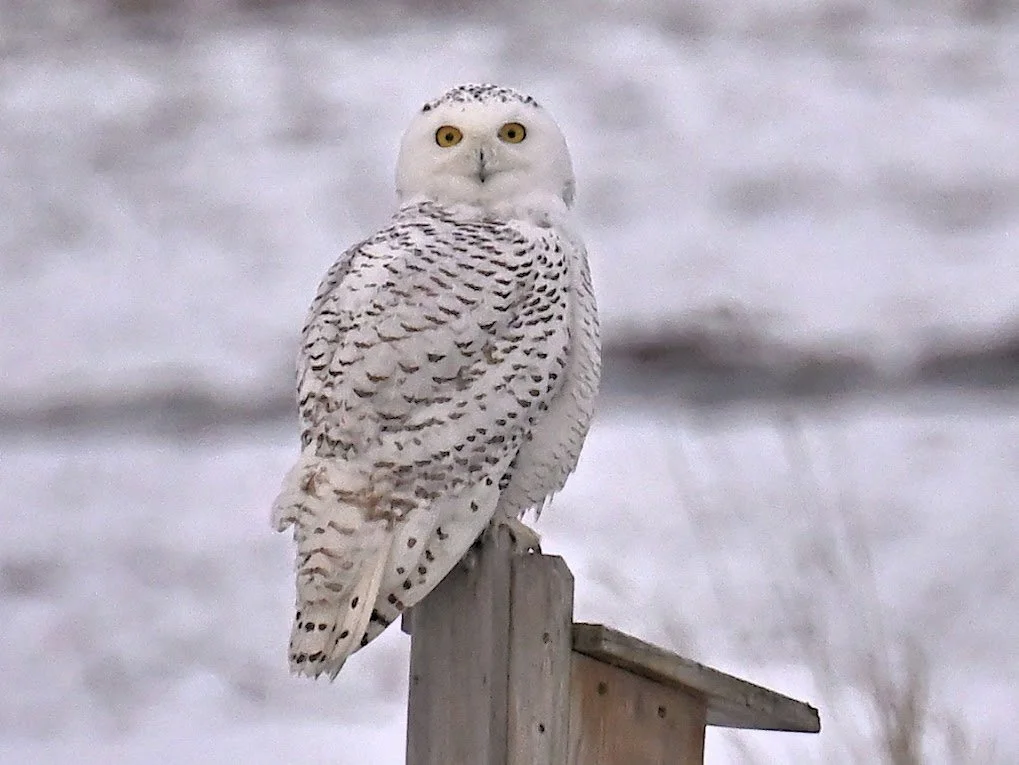
The Snowy Owl is one of 10 species of owl that can be observed in the Shuswap (photo credit John G. Woods)
The Shuswap Naturalist Club started monitoring the movement of birds through our region in September 2024 and has since been able to track the flight paths of specific birds throughout North and Central America. For example, the club has followed a Swainson’s Thrush from the Shuswap all the way to Costa Rica. “We all know that ‘birds fly south’. But with Motus, generalities have become specifics and we have a heightened level of awareness of bird behaviour” says John Woods, member of the Shuswap Naturalists. “This particular bird not only returned to Costa Rica but to the same area it had wintered the year before”.
John explains that Motus helps us understand where the birds have been and where they’re going. “The tracking stations are telling us that there are some birds, who we thought flew in a direct line to areas in Central America, are actually heading east and crossing mountain ranges before they make the long trek south.” Thanks to Motus, we are discovering that migratory routes are far more complex than originally thought.
This detailed information highlights the importance of conservation on a global scale. We might passively observe a diversity of birds in our own backyards but now we have more precise knowledge of where they go when they leave us and how they get there. We gain insight into their world beyond our borders.

Birders count trumpeter swans in the Shuswap River during the Christmas Bird Count (photo credit John G. Woods)
To follow the observations of the Shuswap Naturalists’ Motus tracking station, visit shuswapnaturalist.ca
Christmas Bird Count
The Shuswap Naturalist Club will also be hosting a Christmas Bird Count on December 14. This event started 125 years ago when American ornithologist Frank Chapman proposed counting birds instead of hunting them as a new Christmas custom. I’m sure the birds have been grateful ever since!
Salmon Arm will be divided into areas within a 12km radius and teams will record the different birds they see. There is a social gathering at 3:30 pm at First United where birders can share Christmas treats and the results of their observations.
The results of Salmon Arm’s Christmas Bird Count are sent to Birds Canada who compile a national database. This is used by scientists to track long-term trends in bird populations and helps inform conservation efforts.
The Christmas Bird Count is considered to be one of the world’s oldest “citizen science” projects. It’s so easy, and fun, to contribute! Information can be found on the Shuswap Naturalist Club website under the “Projects” tab, scroll to Christmas Bird Count. You can be assigned to a team or you can conduct a “FeederWatch” from the comfort of your own home.
Whether you have one in your hand or two in the bush; just get out and count those birds! What a lovely (and affordable) activity to add to your holiday traditions.